


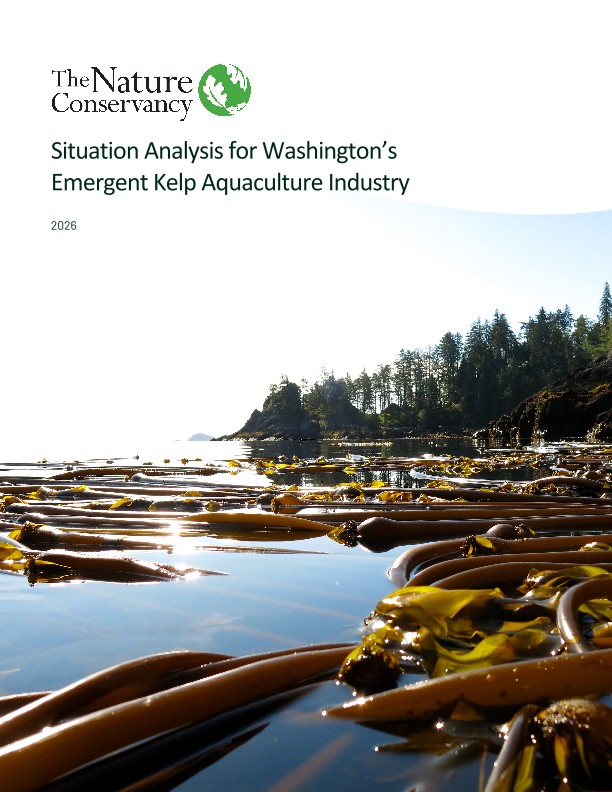
This situation analysis explores the current state of Washington’s kelp aquaculture industry and its potential to support farmers, researchers, Tribal Nations, government agencies, and others interested in cultivated seaweed. It examines opportunities and challenges related to environmental impacts, site selection, economics, policy, and partnerships, and outlines the steps needed to advance a restorative aquaculture industry in the state.
Download
Why Seaweed Aquaculture?
As aquaculture continues to grow worldwide, there is increasing interest in approaches that can produce food and other products while directly supporting healthy coastal ecosystems. This model—known as restorative aquaculture—focuses on farming practices that provide environmental benefits.
When it comes to restorative aquaculture, seaweed cultivation offers significant promise. Seaweed can be used in food, cosmetics, pharmaceuticals, animal feed, fertilizers, biofuels, bioplastics, and other products. It requires no freshwater, fertilizers, or feed inputs and has a relatively small land footprint for processing. Seaweed farms may also improve water quality, create habitat, and contribute to climate resilience.
Opportunity in Washington
Research conducted by TNC and U.S. National Oceanic and Atmospheric Administration (NOAA) identified the Pacific Northwest as one of North America’s most promising regions for environmentally beneficial, socially acceptable, and economically viable seaweed aquaculture. However, the industry still faces significant barriers, including limited markets, financing challenges, evolving regulations, lengthy permitting processes, and a lack of regionally-specific research.
This report highlights these opportunities and challenges while identifying priorities for continued growth of a sustainable and restorative seaweed aquaculture sector in Washington.